
Most people picture permitting as paperwork. You fill out an application, someone reviews it, you get a stamp.
That is not what happens.
Permitting a utility scale project in a rural county is a year long stakeholder campaign that ends in a public hearing where you have very little control. I learned that on a 200 MW battery storage project in Colorado. We got denied at the first hearing. Weeks later we got a unanimous approval at the second.
Nothing about the project changed between those two rooms. What changed was how we made the case.
Here is the full story.
The First Conversations
From my first meeting with county officials to the final approval was about eleven months. The work that decided the outcome started at the very front of that window, before there was an application to submit.
I sat down with the county planning department for a pre-application meeting. Most counties require one, but there is a difference between checking the box and actually using the time. I went in with questions. What does a complete application look like here? What studies do you expect? Are any ordinance changes coming? What has tripped up applicants before?
Reading a county's criteria on paper only gets you so far. Sitting across from the people who apply those criteria tells you what they actually care about, and that is worth more than any document.
Over those same weeks I met individually with each of the three county commissioners. This mattered more than I understood at the time. Colorado's open meetings law means that once your application is in, you cannot have an informal conversation with a commissioner about it. Every discussion has to happen in a public hearing. If you have not built any relationship before you file, you will be a stranger presenting to strangers on the day your project lives or dies.
The three commissioners had genuinely different views. One was supportive of energy infrastructure. One was pragmatic and focused on what the county got out of it. One was skeptical. All three were doing their job. I did not try to sell anyone. I introduced myself, explained what we were exploring, and answered questions.
Months later, when our team stood up in front of them, they knew who I was.
Building the Application
We spent a few months assembling the application, then several more months in back and forth with the planning department after we filed.
That back and forth is normal and it is where a lot of the real work happens. Staff would review, come back with questions, and we would go back to our consultants and update. Over the course of it we produced:
Natural resources surveys, including a raptor nest survey, aquatic resources inventory, and wildlife habitat assessment
A Class III cultural resources inventory
A visual impact assessment with simulated renderings from key viewpoints
A traffic impact study
A noise analysis with sound modeling across the surrounding area
A geological review
An emergency response plan
We coordinated with Colorado Parks and Wildlife, U.S. Fish and Wildlife Service, the Colorado Department of Transportation, and the local fire protection district.
One complication worth naming: the head of the planning department retired partway through our review. The person who stepped in was new to leading a review of this scale. That is not a criticism. It is a reality of rural county government, where departments are small and institutional knowledge walks out the door with one retirement. As the applicant, you absorb that. You explain more, you document more, and you stay patient.
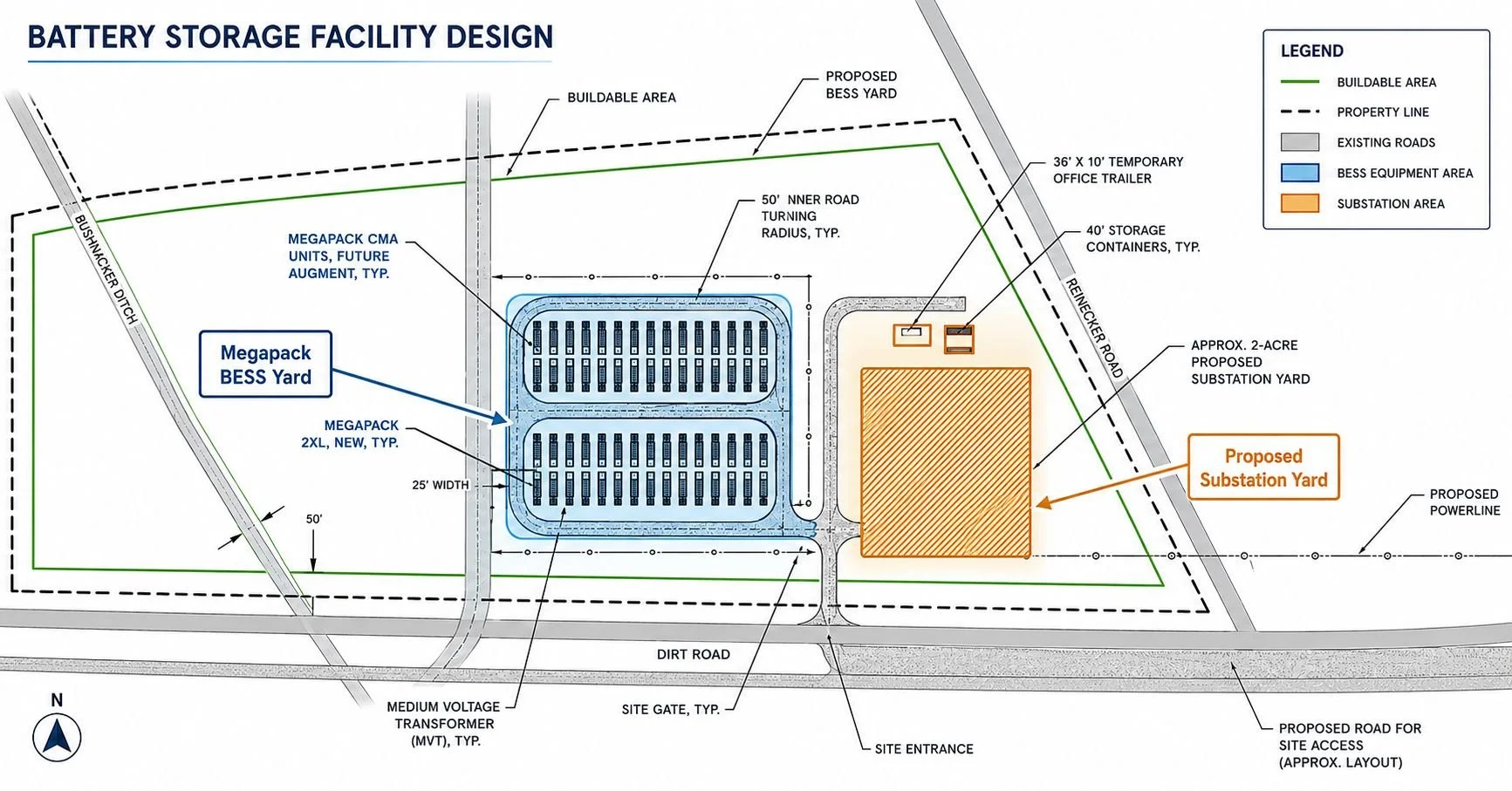
Site plan from the conditional use permit application. The BESS yard and substation occupy roughly 10 acres of a 36-acre parcel.
The Community Work
Everything above is the technical case. It is necessary and it is not sufficient.
Running parallel to the application, we ran a community engagement campaign that lasted most of a year:
Public notice in the local paper and certified mail to stakeholders
A public open house where people could come look at the plans, meet the team, and ask questions in person
Multiple virtual meetings held specifically for HOA members
A dedicated project website, email address, and phone hotline
Months of meetings with the HOA board and individual homeowners
A conversation with a leader at the county chamber of commerce
We worked directly with the fire protection district on the emergency response plan. The fire chief walked through it, revised it, and approved it. We committed to two voluntary 30,000 gallon water tanks that the fire district could use for any emergency in the area, not just an incident at our site. That was not required by code. It was a real gap in the community and we could fill it.
We met with the ambulance district on emergency coordination and training. We met with the school district about the career and technical education program and a long term partnership around workforce training. We met with the county extension office.
And we structured community benefits tied to project success. Annual contributions to the school district, the county fair, 4-H, and the local food bank, plus property tax revenue across the fire district, ambulance district, school district, water conservancy districts, and county government. More than nine million dollars in total local benefit over the twenty year life of the project.
The one thing we did not have locked down was a signed agreement with the HOA.
We had been negotiating a road use agreement for months. The HOA board was supportive. The president was supportive. But he was still working through his own process and had not signed. We had a verbal commitment and nothing on paper.
That gap decided the first hearing.
The First Hearing
Planning staff recommended approval. That is the first real hurdle and we cleared it. In this county, you cannot even get on the planning commission agenda without it.
The hearing ran over three hours. The format is worth understanding, because if you have never sat through one it will surprise you.
Planning staff presents first. Fifteen or twenty minutes summarizing the application, the review, and their recommendation.
Then the applicant presents. We had a thirty slide deck: who we are, what we build, project location and layout, cost, timeline, environmental studies, visual simulations, community benefits.
A logistical note that sounds trivial and is not. There was one podium, off to the side, with room for one person. Our team of roughly ten was scattered through the audience. Different parts of the presentation were given by different experts, so we were queuing up behind the podium and swapping. When a question came in for the environmental lead or the fire protection specialist, we had to point them out and wait for them to come forward. It was disruptive and it made a coordinated team look uncoordinated.
Then the board asked questions for thirty to forty five minutes. Fire safety. Impact on the HOA. Construction timeline. And a fair one: this project sells power to one utility, but most residents here are served by a different cooperative, so how does this help us? The answer is that both are connected at the same substation, so when local power goes down, the cooperative can draw from that line. Grid reliability does not respect utility service territory lines.
Then public comment. Ten or more people spoke. Groundwater contamination. Fire risk. Noise. Visual impact. Some of it was accurate concern about a technology people had never seen up close. Some of it was not accurate.
Here is the part that catches developers off guard: you do not get to respond to any of it until every speaker has finished. Then you get a few minutes, total, for everything.
We tried to answer all of it. Ten concerns, three minutes. None of them got a real answer. I was the one coordinating who stood up and what we covered, so that call was mine, and I have not made it again.
Then the board moved into deliberation. Once that starts, nobody in the audience speaks again. Not the applicant, not the public, not anyone. The floor belongs to the board, and everyone else sits and listens.
That is the hardest part of the process, and it is worth being honest about it. The board is working through the record as they understood it, and if something entered that record inaccurately, it stays there. Points get repeated. Views get shaped. And you have no mechanism to correct anything, so you sit through a long discussion knowing the outcome is being decided on a picture you cannot adjust.
The deliberation turned on one criterion in the county code. The board concluded we had not met it, and voted the project down.
That night was demoralizing. We had done the technical work, cleared staff review, and lost the room.
Regrouping
In this county, a planning commission denial does not end the process. You can still go to the Board of County Commissioners. That is not always advisable, but our timeline did not give us room to restart. The project needed permit approval to hold its offtake agreement with the utility.
So we went. And we rebuilt the case from the ground up.
The insight was simple and I wish I had reached it earlier. A conditional use permit hearing is not a pitch. The board is not deciding whether they like your project. They are applying a written standard. In this county that standard is Section 5-503 of the land use regulations, and it lists seven criteria, A through G:
A. The proposed use is an authorized conditional use in the zone district
B. The property's geological, physical, and environmental conditions are compatible with the use
C. The use conforms to zone district requirements and does not create a substantial safety concern
D. The property has reasonably certain permanent legal access
E. Access from the public thoroughfare meets county road standards
F. The use is compatible with surrounding properties and zoning
G. Conflicts with enforceable covenants and restrictions of record are considered
Our first presentation had been about the project. Our second presentation was about the code.
We gave each criterion its own section and walked through exactly how the project satisfied it, with evidence. The criterion we had been denied on got the most attention. We laid out the emergency response plan developed with the fire chief, compliance with NFPA 850 and 855, the battery management system and site controller with emergency shutdown capability, the two water tanks, restricted site access with no public entry, and the fact that every referral agency comment had been addressed and closed.
We also closed the gap that had cost us the first hearing. The road use agreement with the HOA got signed. The county attorney reviewed and approved the legal access memorandum. What had been a verbal understanding was now a document we could hand to the board.
Outside the room, we kept working. By the second hearing we had letters of support from the fire district, the ambulance district, the school district, the county extension office, the HOA, the utility, and individual residents. We had signatures from roughly thirty neighbors, including people the community knew and respected.
The Second Hearing
Same format. Different outcome.
We presented the code, criterion by criterion. When public comment came, the fire chief spoke in support. The HOA president spoke in support. A neighbor with an energy background spoke in support.
There were still people who spoke against the project. That does not go away, and it does not need to. The change was in how we used our rebuttal.
We had three minutes, and it was the last thing the board would hear before going into deliberation where nobody else could speak. Spending it defending against every objection would have wasted it. Most of those concerns had already been answered in our presentation, with studies and agency sign-off behind them. Repeating the answers would only have kept the board thinking about the objections.
So we thanked people for their comments, said we would gladly meet one on one with anyone who wanted to go deeper, and then spent the remaining time on what the project delivers and how it satisfies each criterion in the code. We treated the rebuttal as framing, not defense. The last thing in the room before deliberation was the affirmative case.
The board approved the permit unanimously, with conditions covering drainage, erosion and stormwater management, dust and noxious weed control, native and drought resistant vegetation, wildlife friendly fencing per Colorado Parks and Wildlife standards, a noise analysis and compliance with the county noise ordinance, downward facing shielded lighting, a decommissioning agreement, and a performance bond covering decommissioning cost.
All reasonable. All accepted.
The project is now moving toward construction.
What I Took From It
Meet everyone before you file. Once the application is in, open meetings law closes the door on informal conversations with decision makers. The relationship has to already exist.
Get it in writing. A verbal commitment from a supportive stakeholder is worth nothing in a hearing room. If you cannot hand it to the board, it does not exist.
A hearing is not a pitch. Find the written standard the board is applying and build your entire case around it, section by section. Make it easy for them to say yes on the record.
Your rebuttal is framing, not defense. It is the last thing the board hears before a discussion you cannot participate in. Acknowledge the comments, offer to talk one on one, and spend the time you have left on the affirmative case.
Give the community something real. Not a marketing gesture. A water tank the fire district actually needs. A workforce program the school district actually wants. Revenue the districts can actually budget around. When those relationships are real, people stand up for you without being asked.
Nobody is the villain. The county wanted responsible development and a stronger tax base. The fire district wanted safety. Neighbors wanted to protect what they have. Every one of them was doing their job. The developer's job is to find the version of the project where all of that is true at once.
_____________________________________________________________________________________________________________________________________________________________
By Jonathan Berry, Founder & Principal. Jonathan led this project as a development manager at a utility-scale renewable energy company before founding Brighter Nations.
Brighter Nations provides outsourced development leadership and owner's representation for utility scale solar, storage, and infrastructure projects. If you have a project working through permitting, interconnection, or stakeholder complexity, reach out at jonathan@brighternations.com.
